Dig Deeper into Sunday’s Gospel: Read Matthew 21:33–44
Recently, I spent time with a group of women who were being asked to let go of something beautiful.
For years, these women had formed deep friendships in their Walking with Purpose small groups—studying Scripture, praying for each other, carrying one another through hard seasons, celebrating answered prayers, and learning to trust each other with tender moments of their lives.
And now they were being encouraged to switch groups in order to meet, invite, and welcome new women. I understood the discomfort they felt in response to this ask. Because when God grows something beautiful, often our instinct is to do what we can to protect it.
But as we talked, questions arose that led to a deeper conversation: What if God grew the good fruit in their groups not just for them, but for others as well? What if letting go didn’t mean losing something beautiful, but instead meant that we are entrusting it back to God so that it could bless others?
The Vineyard Was Never Ours
In this Sunday’s gospel, Jesus shares a parable about a landowner who “planted a vineyard, put a hedge around it, dug a wine press in it, and built a tower. Then he leased it to tenants and went on a journey” (Matthew 21:33).
Before the tenants ever began their work, the owner had already labored in His vineyard, had already planted, prepared, provided. He left something beautiful in their care, entrusting them to cultivate it and make it fruitful.
When vintage time came, the tenants refused to give the owner his produce. They mistreated his servants and eventually killed his son, hoping to seize the inheritance (Matthew 21:38–39). They no longer wanted to simply tend the vineyard—they wanted ownership, to possess it.
Here the parable points beyond the vineyard to Jesus Himself. The Son who comes to claim what belongs to the Father is rejected and killed. The tenants’ desire to possess the vineyard ultimately leaves no room for the Son.
Before we distance ourselves too quickly from these tenants, let’s take a closer look. Because we, too, can often forget whose vineyard it is.
When Stewardship Becomes Ownership
God entrusts each of us with vineyards: children to raise, relationships to nurture, gifts to cultivate, work to accomplish, ministries to serve, resources to steward, dreams to pursue, lives to live.
We pour ourselves into these vineyards—sacrificing, praying, planning, loving, suffering losses, and celebrating harvests. And because we pour so much of ourselves into them, we can slowly begin to believe that what God has entrusted to us belongs to us.
My children. My family. My plans. My career. My future. My time. My life. Mine.
We begin to forget the Owner who planted and prepared the vineyard before placing it into our care. Our posture shifts from tenant—or steward—to owner.
Saint Francis de Sales offers a beautiful image for another way to live. He compares us to a gardener tending a king’s garden. The gardener, he notes, ought to exercise even greater diligence in cultivating the royal garden precisely because it belongs to the king. He writes, “Our possessions are not ours—God has given them to us to cultivate, that we may make them fruitful and profitable in His Service.”[1] Though Saint Francis is referring to material possessions, his image offers a lens through which we can view all that God has placed in our care.
What if we lived as gardeners—or tenants—rather than owners in the vineyards the Lord has entrusted to us?
This practice of spiritual detachment does not ask us to stop caring about or laboring for what we have been given, but to cultivate these gifts without forgetting to whom they belong. We are called to steward them so they may be fruitful in service to our King, rather than to ourselves.
One way to recognize when our stewardship has begun to slip into ownership is to notice how we tend what God has given us. Saint Francis describes self-love as “restless, anxious, over-eager,” while the love of God is “calm, peaceful, and tranquil,” making the work done for His sake “gentle, trustful, and quiet.”[2]
Are we tending our vineyards with the peaceful diligence of a steward, out of love for God? Or are we clinging to them with the anxious grip of an owner, our worth tied to their outcome, perfection, appearance, or our own comfort?
When God Asks for the Fruit
The tenants’ attachment was ultimately revealed when the owner asked for the produce—his produce, the good fruit of his vineyard. Sometimes the hardest things to surrender to God aren’t the bad things; they are the good things that He has grown.
Spiritual detachment provides us the interior freedom of a steward: the freedom to love and tend God’s gifts without needing to control what happens to them. We are free to hold them lightly, trusting them to the service of the Owner’s will. Free to delight in the goodness of God, declaring, “by the Lord has this been done, and it is wonderful in our eyes” (Matthew 21:42).
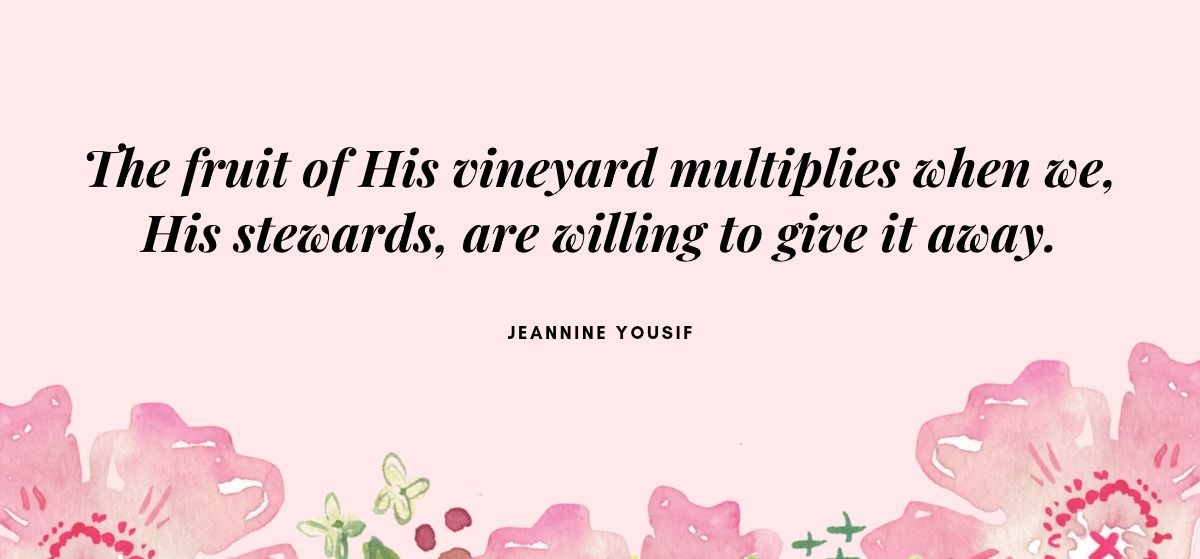
Our focus then shifts outward to mission: welcoming and receiving the Son when He comes and, with a generous spirit, obeying His call to share what we have received according to His will. The fruit of His vineyard multiplies when we, His stewards, are willing to give it away. The Owner can do far more with the fruit He has grown when we offer it back to Him rather than holding onto it for ourselves.
An Invitation to Surrender
Like the tenants, our reaction to the possibility of losing something we love can reveal how tightly we are clinging to it. We may even be unable to recognize our attachment until the moment God asks us to open our hands and release it.
The women I mentioned earlier aren’t being asked to erase the friendships God had formed or pretend they aren’t meaningful. Instead, they are invited to trust that the very fruit He had cultivated among them was now meant to be given away to nourish someone else.
And, maybe that is an invitation for us, too. To love without possessing. To tend without controlling. To receive with gratitude, and then release with trust and faith.
We are tenants, not owners of all that we have been given. We are gardeners tending the King’s garden. And when vintage time comes, may we receive His Son joyfully, opening our hands to offer the Owner His fruit, remembering that the vineyard has always belonged to Him.
Holding lightly,
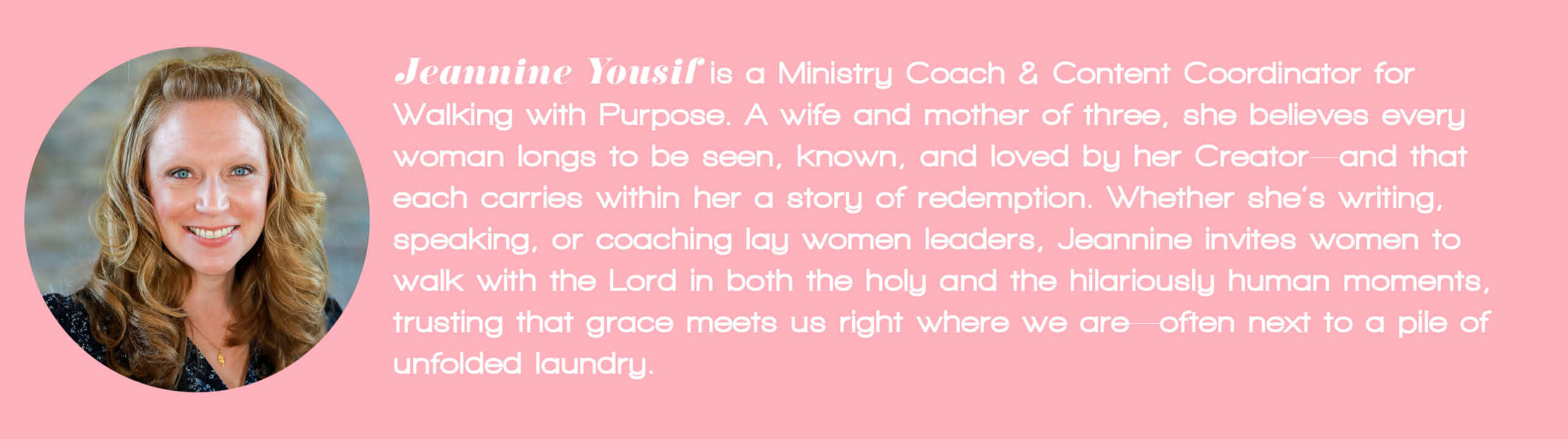
Jeannine
Food for thought or journaling …
Where in my life is God inviting me to move from the anxious grip of an owner to the peaceful trust of a steward? What fruit has God grown in my life that He may now be asking me to share?
Lord Jesus, You know how tightly I can hold the people, plans, and gifts I love. Remind me that everything I have first came from Your hands. Give me the grace to tend faithfully what You have entrusted to me and the freedom to place it back into Your hands when You ask. Teach me to trust You with the vineyard and its fruit. Amen.
[1] Saint Francis de Sales, Introduction to the Devout Life (San Francisco: Ignatius Press, 2015), 103.
[2] De Sales, Introduction to the Devout Life, 103.
P.S. Looking for a community of women grounded in faith, rooted in love of Christ, and faithful to studying His Word? It’s not too late to find a Walking with Purpose group near you. Whether at a parish, home, or even on a screen, there is always an open seat waiting for you.