Dig Deeper into Sunday’s Gospel: Read Matthew 22:1–14
Weddings are some of the happiest occasions not only for the bride and groom, but also for those closest to them who have the joy and honor to witness the beginning of a new chapter of life. Everyone knows that when an invitation to a wedding arrives in the mail, a few steps are involved. First, you decide whether or not you will accept the invitation. Will you attend the wedding, or is there a conflict in your life that prevents you from being there? Should you accept, then you must decide what to wear. Dressing appropriately is necessary and right. And finally, you must actually show up to the event to partake in the ceremony and feast.
This Sunday's gospel once again illustrates Jesus' use of parables to teach the priests and the elders. This is the fifth consecutive week we have heard Jesus teach through parables, and the third week in which Jesus specifically addresses these religious leaders.
Jesus recognizes in them a love for power and a deep attachment to authority, which ultimately supersedes their willingness to believe in Him and blinds them to the hardness of their hearts. Their desire to safeguard and self-protect, coupled with their unwillingness to reconsider their assumptions, prevents them from recognizing the promised Messiah, the very Son for whom the King has prepared a wedding feast.
Though addressed to the chief priests and elders, at its heart, this parable is about God's invitation to every human heart to participate in a life with Him. The Catechism of the Catholic Church reminds us that, "the invisible God, from the fullness of his love, addresses men as his friends, and moves among them, in order to invite and receive them into his own company. The adequate response to this invitation is faith" (CCC 142). Ultimately, Jesus challenges us with a question: how will we respond to the love of God?
As evidenced in the parable, many people, those who are on the original invitation list—those who presumably should have been the first to accept the invitation—reject it instead. When the invitation is first extended, they flatly refuse. When the king sends his servant a second time, announcing that the feast is prepared and ready, some ignore it altogether, choosing to take care of matters and obligations they deem more important. More startling still are those who mistreat and even kill the king's servants—a shocking act of rebellion and flagrant mutiny against the king himself.
While Jesus implies that it is the chief priests’ and elders' preoccupation with status and power that is leading to their rejection of the invitation, we would do well to pause here and examine our own hearts, inviting the Holy Spirit to illuminate our minds and discern our thoughts.
What competes with God's invitation in my own life?
What concerns, ambitions, attachments, priorities, or distractions prevent me from responding swiftly and wholeheartedly to Him?
In what ways am I failing to cultivate the gift of faith?
Radically, in a way that offers hope for those of us of “lesser status,” the king extends his invitation to everyone—both "bad and good alike" (Matthew 22:10). These are the people who readily say yes, who join in the feast, who delight in the king's company. And yet, fascinatingly, we learn that accepting the invitation is not enough. One guest arrives improperly dressed for the occasion. Thus, we learn that to accept the invitation without wearing the necessary attire is not only to disgrace the king, but to receive the harshest and gravest punishment (Matthew 22:11–13).
What then is this garment? It is the visible marks of discipleship, the fabric of a life embroidered by the works of our faith. As Saint Paul writes in his letter to the Colossians, "Put on then, as God’s chosen ones, holy and beloved, compassion, kindness, lowliness, meekness, and patience, forbearing one another and, if one has a complaint against another, forgiving each other; as the Lord has forgiven you, so you also must forgive. And above all these put on love" (Colossians 3:12–14).
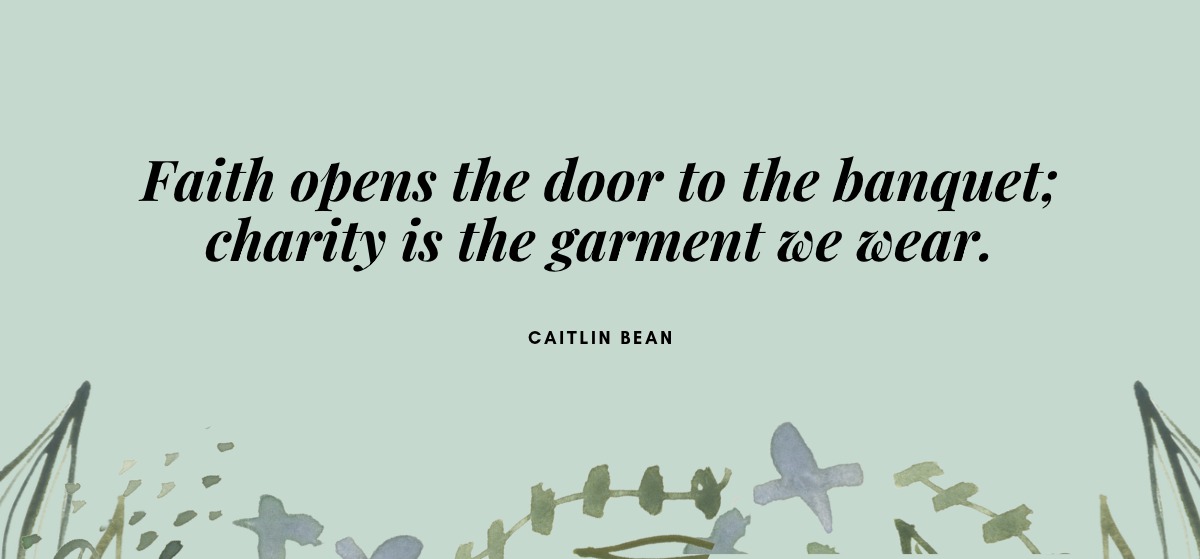
These are the threads of the wedding garment. Compassion, humility, forgiveness, patience, and above all, love, are the fabric with which every disciple is called to be clothed. Faith opens the door to the banquet; charity is the garment we wear as the King's chosen guest to remain in His presence and be captivated by the beauty of His endless, merciful love.
Food for thought or journaling ...
What thread of the wedding garment—compassion, humility, forgiveness, patience, love—is God asking you to cultivate?
Heavenly Father, thank You for the invitation to delight in Your company. Thank You for loving me so deeply that You desire to be with me for all eternity, and for bestowing upon me the gift of faith through which I am able to respond to Your invitation. Instill in me the desire to cultivate a faith that is persevering and steadfast. Illuminate my heart so that I recognize that which competes with Your love and draws me away from You. Come alongside me, Lord, and transform me by Your grace, so that I may actively participate in the work of being clothed by Your love. Teach me to weave the threads of compassion, humility, forgiveness, patience, and love into my garment, so that when the day comes that I am called to the feast, I am clothed radiantly and in a manner that is worthy and pleasing to You. Amen.