Dig Deeper into Sunday’s Gospel: Read Matthew 21:1–11
Imagine you are walking through a crowded parking lot when you spot a stranger calmly sliding into the driver’s seat of your brand-new car. Naturally, you confront him, demanding to know what on earth he thinks he’s doing. Without a hint of panic, he simply looks at you and says, “The master has need of it.” Chances are, you aren't handing over your keys—you're calling the police! This is essentially what Jesus instructed two of His disciples to do at the beginning of this Palm Sunday gospel.[1]
We read in the Gospel of Matthew that Jesus and His disciples approached Jerusalem leading up to the feast of the Passover. It was Jewish custom to make a pilgrimage to the holy city to offer God a ritual sacrifice in commemoration of the exodus out of Egypt by Moses and their ancestors. Consequently, this drew a vast multitude journeying in the same direction on foot, as was their tradition.
So when Jesus asked His disciples to find and bring a donkey from a nearby village that He could ride into the city, it would have given pause to the first-century Jews. “Fulfilling Zechariah’s prophecy (entering the Holy City on a colt never before mounted) and with the people imitating past celebrations of mighty Jewish victories (paving the road with palm branches), Jesus Christ becomes a living billboard announcing his claim to be the Messiah.”[2]
However, the very people who laid down their cloaks and palm branches, singing “Hosanna to the Son of David; blessed is he who comes in the name of the Lord” (Matthew 21:9), only days later were the same onlookers shouting “Let him be crucified!” (Matthew 27:22). The crowds rallied behind Jesus when He appeared to be fulfilling their expectations. Still, when His kingship took the form of humility and self-sacrifice rather than political power and authority, they readily traded their role as followers for that of accusers.
These onlookers were hoping Jesus would be the Messiah, but only so long as He fit their mold. They were hoping He would be the long-awaited redeemer who would overthrow their Roman oppressors and reclaim their independence. But this Jesus they were cheering had far greater dreams for His people. Political power and social status paled in comparison to what He actually did—tearing down the dividing wall that keeps His beloved children from paradise. And so, by choosing restoration over rebellion, He traded His gold crown for one of thorns.
We might be tempted to see ourselves as on the right side of history, knowing with certainty that of course Jesus’ mission wasn’t to reestablish political rule but to save all mankind. But if we look a little closer, do we suffer from the same short-sighted expectations as our first-century friends? Let’s consider:
When I don’t get my way, do I pick up my palm branches, turning from Christ in frustration?
When God’s timing is not my own, do I scoop up my cloak and walk away in disappointment?
When the Lord’s path for me is marked by setback, hardship, humiliation, and loss, do I look for another god of my making? How quick am I to fashion idols that can fit in my pocket—small enough to pull out when I need a savior—but tame enough to require nothing of me?
God rarely moves in the ways we anticipate. Jesus could have summoned legions of angels on the road to Jerusalem to assert His kingship, or He could have chosen a path to salvation far less agonizing than the cross. In the same way, He has the power to swoop into our lives and instantly right every wrong. Yet, this is often not how He chooses to work.
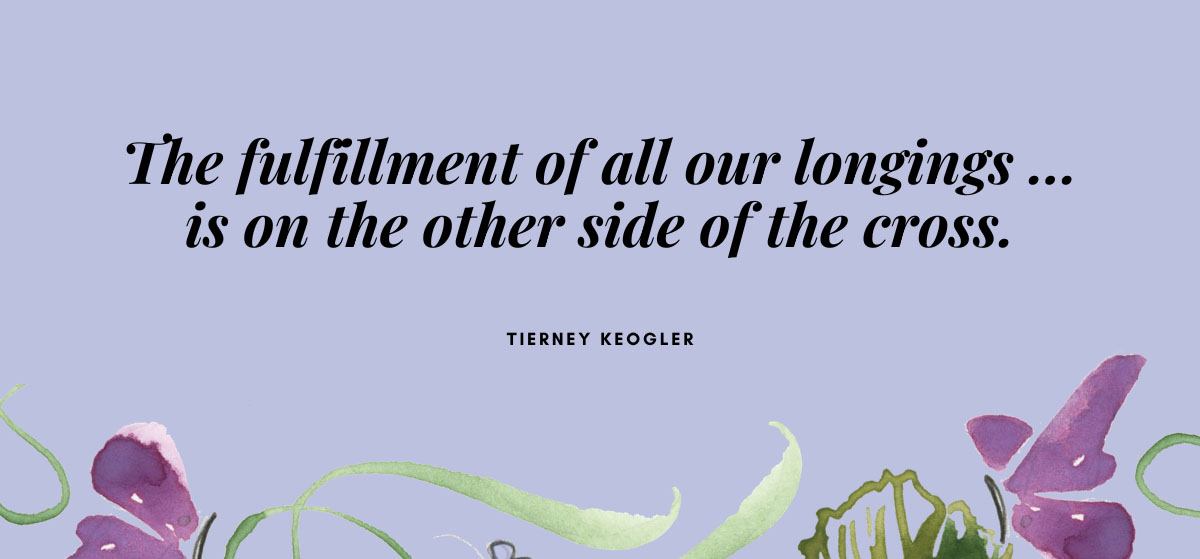
It is easy in these moments to conclude that God doesn’t care, He isn’t good, or He doesn’t know what He is doing. When we feel disappointed, weary, or discouraged, it is an easy leap from the praise of “hosanna” to the condemnation of “crucify Him.” Turning to Scripture helps us gain an eternal perspective: “Whoever wishes to come after me must deny himself, take up his cross, and follow me” (Matthew 16:24). Jesus did not avoid the cross, and He gently but insistently reminds us that neither can we. The fulfillment of all our longings, the resolution of all our conflicts, the healing of all that ails us, is on the other side of the cross.
"The message of the cross is foolishness to those who are perishing, but to us who are being saved it is the power of God" (1 Corinthians 1:18). And yet, this power looks nothing like the world expects. The world pursues status and prestige, but Jesus shows us another way. He enters Jerusalem on a humble donkey. The night before His Passion, He washes His disciples’ feet, the lowest act for even a slave to do. Then He chooses to die for an ungrateful world that has abandoned Him in His greatest act of mercy.
Who are we in this story? As we accompany Jesus this week, let’s place ourselves in the narrative.
Are we waving palm branches, shouting “Hosanna in the highest,” or are we fair-weather friends who betray Him when He doesn’t meet our expectations?
Are we one of the disciples who “could not keep watch for one hour,” or are we the unassuming woman who wipes Jesus’ face?
Are we the rash apostle who denies our Lord when it costs something? Or are we the one who helps our Lord carry His load?
Are we at the foot of the cross to see it all, to take in the greatest display of love and mercy, and to receive this free gift undeservedly but gratefully?
Remember, dear sister, the cross isn’t the end of the story. Each moment, we are given the opportunity to decide who we want to be in the greatest story ever told. Because it is still being told. We are a part of the great adventure that is salvation history. During this holiest of weeks, we can recommit ourselves to claiming the victory the Lord so lovingly bought for us with His blood. And if you find your circumstances look more like Good Friday than Easter Sunday, remember that God sees what you cannot yet see and is working a good you cannot yet imagine.
Let’s stay close to our Lord this Holy Week as we accompany Him to Calvary, so that we don’t miss a single word He wants to speak to us. Let’s journey with Him to the cross and put to death all sin and disorder in our hearts. Let’s wait with Him in the tomb in trust and hope. And let’s see what Jesus can resurrect in our hearts in a few short days.
With you at the cross,
Tierney
Food for thought or journaling …
What "pocket idols" do you turn to when God feels distant or slow to act? Which character in the Passion narrative do you most identify with? How might God be inviting you to surrender more fully to Him this week?
Dear Jesus, draw me close to You as we approach Your Passion. Reveal the obstacles in my heart that keep me from fully embracing Your love. Help me to die to myself so I can rise with You in freedom and joy. Amen.
P.S. Want to stay close to Jesus this Holy Week? Consider bringing these questions to your Praying from the Heart: Guided Prayer Journal, and let Him speak to your heart in the silence.
[1] Dr. Brant Pitre, "Holy Week," Formed, accessed March 12, 2026, https://watch.formed.org/holy-week-by-dr-brandt-pitre/videos/holy-week.
[2] John Bartunek, The Better Part: A Christ-Centered Resource for Personal Prayer (Manchester, NH: Sophia Institute Press, 2021), 242-243.