Dig Deeper into Sunday’s Gospel: Read Matthew 5:1-12
I love "life hacks"—so much so that my family knows I'll usually have one ready for just about anything. Did you know that if you take a wet sponge, run it over a window pane, and stick sheets of aluminum foil to it, you have instant blackout curtains? It's oh-so-helpful when you're traveling with little children and want to avoid waking up at dawn.
Or if you put your hard-boiled eggs in an ice bath as soon as they're done cooking, then use a metal spoon to tap them and start peeling the shell, it usually comes off in one long, satisfying piece?
And though hacks are useful, enjoyable, and can even make your life run a bit more smoothly, there's one thing you can't hack. One thing with no loophole, no shortcut, no clever workaround: the condition of the heart and being welcomed into eternal life.
The path to heaven is straightforward, but not casual: surrender your heart, receive His mercy, live out the gospel, follow the commandments, and walk blamelessly before the Lord (Genesis 17:1).
And how are we to live it?
Jesus gives us a model for how to live and explains it with great simplicity (though we should not confuse simplicity with ease), so that the path is approachable for all. When Jesus speaks the beatitudes, He does not limit them to a select audience but for all who are willing to listen, all who have ears to hear. He offers words of life without restriction, and that in and of itself is a lesson.
So where does Jesus begin? What kind of foundation does He lay for those who listen—not merely for those standing before Him but for generations to come?
He begins with a blessing that sets the tone for everything that follows: "Blessed are the poor in spirit, for theirs is the kingdom of heaven" (Matthew 5:3).
And who are the poor in spirit? Not the proud, or the arrogant, or those who find security in wealth, status, and achievement. But the humble, the contrite, those who freely choose lowliness of heart. Indeed, Jesus models this poverty of spirit in the very way He enters our world.
Jesus begins here because to be poor in spirit is the antidote to pride, the vice that is at the root of all sin, the source of every great fall. It was pride that caused Satan to rebel against God, and Adam, whose pride cost him Eden, pride that continues to fracture relationships and distort truth.
Before He speaks of mercy, purity, peacemaking, or suffering, Jesus lays the foundation: poverty of spirit, lowliness. For without this, nothing else stands. Fasting is vain, prayer is a motion, almsgiving is self-seeking.
But why does Jesus say poor rather than humble? St. John Chrysostom helps us understand the depth of this blessing: "Because this is more than that. For He means here them who are awestruck, and tremble at the commandments of God."[1]
In his wisdom, Saint Ignatius of Loyola encourages how to live out this lowliness: “For this it is necessary to make ourselves indifferent to all created things, in all that is allowed to the choice of our free will and not prohibited to it; so that, on our part, we want not health rather than sickness, riches rather than poverty, honour rather than dishonor, long rather than short life, and so in all the rest.”[2] In other words, we must learn the holy art of detachment, not from people—image bearers of our Lord—but from things of this world that capture our hearts and inflate our pride.
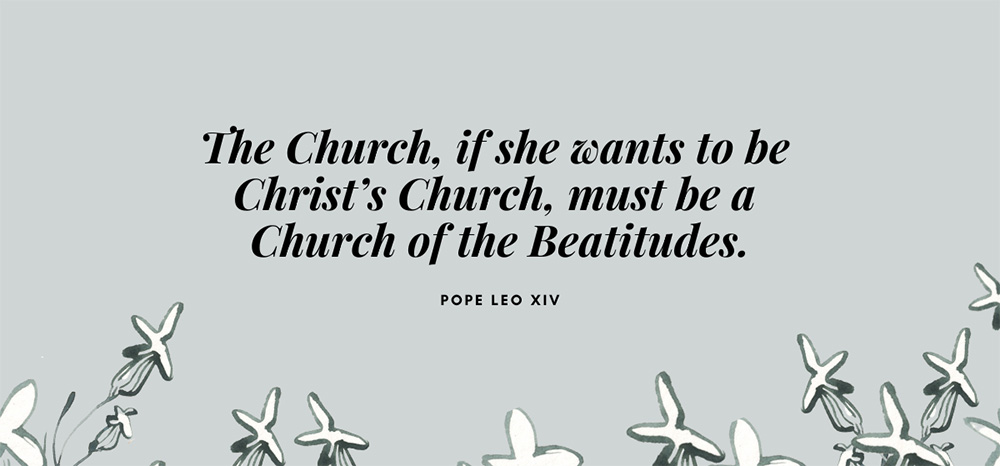
Pope Leo XIV, in his Apostolic Exhortation, Dilexi Te, writes: "And the Church, if she wants to be Christ’s Church, must be a Church of the Beatitudes, one that makes room for the little ones and walks poor with the poor, a place where the poor have a privileged place."[3]
The kingdom of God is not given to the clever, astute, secure, or accomplished. Not to monarchs, influencers, the powerful, or impressive. It is given to the poor in spirit, to those who know they need God.
And therefore, no one is excluded: slave or free, educated or uneducated, refugee or citizen, wealthy or poor, child or adult.
So may we be a Church of the beatitudes, dear sisters, even—and especially—when this requires us to let go of ideologies, or idols, or preconceived notions.
Food for thought or journaling …
Pope Leo XIV urges us to be a “Church of the Beatitudes.” How might God be calling you, with your gifts and talents, to help your parish become a community that makes room for the little ones, walks with the poor, and creates a privileged space for those who are overlooked? If you're already doing this work, how might God be calling you to go deeper?
Jesus, reveal to me the areas of my heart that are inflated by pride and help me to more perfectly become poor in spirit so that I might enter the kingdom of heaven. Amen.
[1] Joannes Chrysostomus, The Homilies of S. John Chrysostom: On the Gospel of St. Matthew, (United Kingdom: W. Smith, 1883), 199.
[2] St. Ignatius of Loyola, The Spiritual Exercises of St. Ignatius of Loyola (United States: P. J. Kennedy & Sons, Printers, 1914), 19.
[3] Pope Leo XIV, Apostolic Exhortation, Dilexi Te (Rome: Libreria Editrice Vaticana, 2025), #21.